Technical
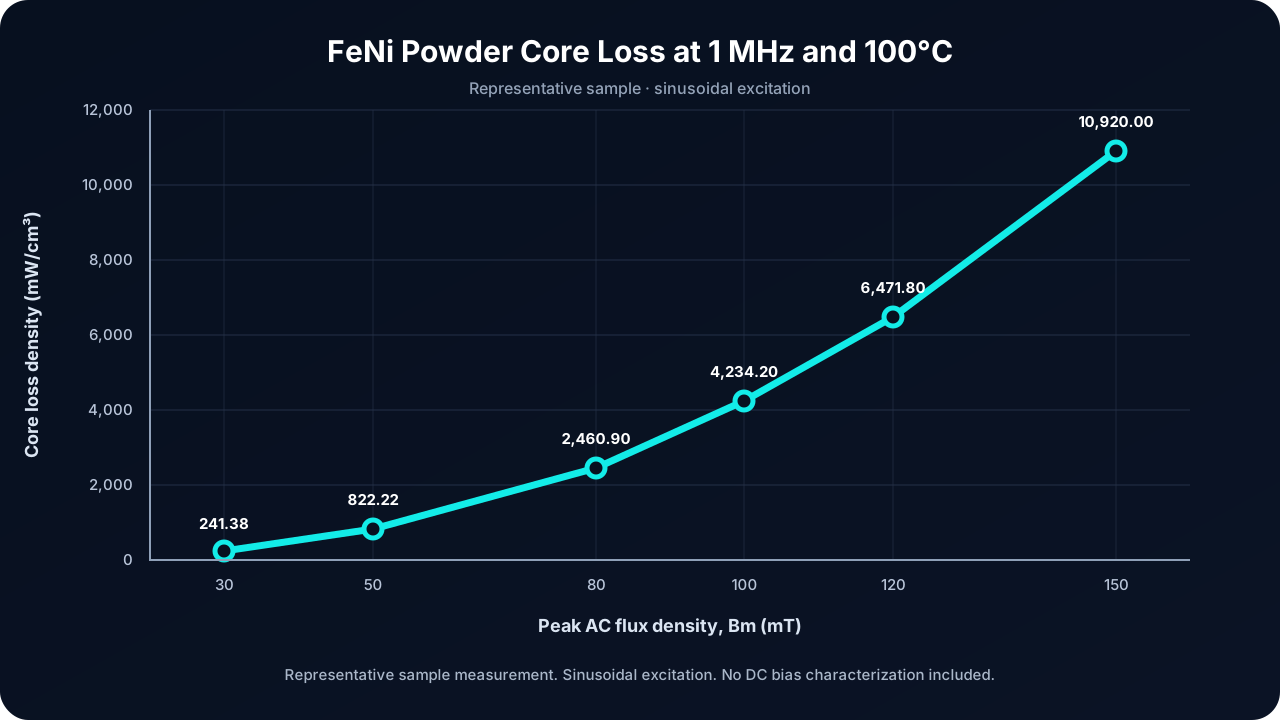
FeNi Powder Core Loss at 1 MHz: The Impact of Flux Density
Explore measured FeNi powder core loss at 1 MHz and 100°C, and see how flux density affects material evaluation for high-frequency power inductors.
来自工程团队的对比指南、选型笔记与实测数据——面向正在选择铁镍粉芯与铁氧体磁芯的设计工程师。
技术文章正文为英文。
38 篇文章
Explore measured FeNi powder core loss at 1 MHz and 100°C, and see how flux density affects material evaluation for high-frequency power inductors.
Custom ferrite cores for high-frequency transformers: when a catalogue core is not enough, what to specify, material grade and geometry selection, tooling, sampling and verification steps.
Custom molded power inductor development and sourcing: what to specify, material and winding selection, tooling, sampling timelines, verification steps and supply planning.
FeNi powder cores for server power supplies: how high-current output stages, DC bias and rack thermal limits shape magnetic core selection for modern server power architectures.
FeNi powder cores for telecom power systems: 48V DC plant architecture, rectifier and DC-DC stages, wide-temperature outdoor cabinets and high-current filtering requirements.
Ferrite cores for EV charging systems: isolated DC-DC stages, on-board charger topologies, auxiliary power supplies, EMI filtering and automotive qualification requirements.
Ferrite cores for isolated DC-DC converters: flyback, forward, push-pull, half-bridge and full-bridge topologies, gapped versus ungapped cores and how topology drives transformer selection.
Ferrite cores for LLC resonant converters: resonant tank behavior, gapped core requirements, transformer and resonant inductor roles, loss considerations and core selection criteria.
Ferrite cores for phase-shifted full-bridge converters: leakage inductance in the ZVS transition, ungapped transformer design, flux balancing, duty-cycle loss and core selection criteria.
Molded power inductors for automotive electronics: ADAS processor rails, ECU power supplies, automotive DC-DC converters, thermal cycling, vibration and AEC-Q200 qualification.
Molded power inductors for industrial electronics: wide input voltage ranges, harsh environments, long service life, thermal design and selection criteria for industrial power supplies.
Molded power inductors for POL converters: low-voltage high-current rails, MHz switching, transient response, DCR, saturation and thermal limits on dense boards.
Molded power inductors for server power systems: low-voltage high-current rails, board density, vertical power delivery, DCR and saturation trade-offs and thermal design in dense systems.
FeNi vs Sendust powder cores: saturation (Bs), core loss, DC bias stability, permeability, temperature and cost. Choose the right powder core for PFC, high-current inductors and EMI filters.
High current power inductor design guide: core material selection (FeNi vs ferrite vs Sendust), DC bias saturation, core loss calculation, DCR, thermal management and sizing for EV, server and solar.
Solar inverter inductor selection: boost stage, PFC stage and EMI filter. Core material comparison (FeNi, Sendust, ferrite) for string inverters, microinverters and three-phase solar systems.
IEC 63299 magnetic powder core classification explained: material families, permeability codes, grades and typical magnetic properties for powder core selection.
EE vs ETD ferrite cores: rectangular vs round winding windows, copper fill, power range, EMI and cost. Choose the right transformer core for your design.
ER ferrite cores for high-power transformers: round center leg and window improve copper fill and reduce loss. Applications in SMPS, PFC and LLC converters.
FeNi vs MPP powder cores for high-current inductors: permeability, saturation, core loss, DC bias, temperature and cost. Choose the right alloy core.
How to select ferrite cores for DC-DC converters: buck/boost inductor design, transformer cores, frequency and current limits, and when powder cores win.
How to select ferrite cores for high-frequency transformers: MnZn material grades for 100 kHz–1 MHz+, core shapes, core loss and saturation flux limits.
How to choose ferrite cores for SMPS: transformer and inductor selection by frequency, power, core loss and shape. MnZn ferrite for switch-mode supplies.
Ferrite cores for solar inverters: MPPT boost inductors, DC-AC transformer cores, high-temperature outdoor operation and when FeNi powder cores win.
Ferrite core manufacturer in China: what to check before sourcing — quality systems, material grades, tooling, testing, samples and factory capabilities.
Ferrite core shapes explained: E, EI, EFD, PQ, RM, toroid, pot and planar. Compare winding area, EMI, profile and applications.
Ferrite material properties: permeability, core loss, saturation flux density, resistivity, impedance and Curie temperature, with datasheet tips.
High-frequency inductor manufacturer RFQ guide: what to specify (frequency, current, inductance, thermal, size) and what to verify in testing and qualification.
Inductors, transformers, chokes and cores for power electronics: how to select them and what to verify when sourcing from a magnetic components manufacturer.
MnZn vs NiZn ferrite: permeability, resistivity, frequency range and loss compared. Choose the right material for transformers, EMI chokes and power inductors.
NiFe (iron nickel) core manufacturer capabilities to verify: alloy control, permeability grades, pressing and heat treatment, testing, AEC-Q200 qualification.
Power inductor specification guide: inductance, saturation current, DCR, core loss, temperature rise and size, with a manufacturer RFQ checklist.
Compare ferrite vs iron nickel (FeNi) powder cores: saturation flux density, core loss, DC bias, temperature range, EMI and cost. See which core material fits your power inductor design.
How to choose magnetic core material for high-frequency inductors: core loss, permeability stability, saturation and cost. FeNi vs ferrite vs Sendust vs MPP selection guide for MHz power electronics.
How to choose a reliable inductor and magnetic core manufacturer: capacity, certifications (IATF 16949, AEC-Q200, ISO), engineering support, lead time and supply chain stability.
How to choose inductors for AI GPU VRM designs (H100, B200): MHz switching frequency, high-current density, core loss, DC bias stability and thermal performance.
How inductors work in EV chargers and OBC: PFC boost, LLC resonant, EMI filtering and output filtering. Requirements for 800V platforms and AEC-Q200 FeNi cores.
What are powder cores? How FeNi, Sendust and MPP powder cores work, their permeability, saturation and loss differences, and which to choose for power inductors.